Explained. Karnataka Courts – Service of Summons/ Notices/Processes/Documents (Civil Proceedings) by Electronic Mail Rules, 2024’.
02-March-2025 11:59
Karnataka Courts – Service of Summons/Notices/Processes/Documents (Civil Proceedings) by Electronic Mail Rules, 2024’.
Key Features of E-mail Services Rules 2024
Purpose: To modernize and expedite the service of court summons, notices, and processes by using electronic mail.
Why Needed?:
Delays in service of summons and notices cause significant judicial delays.
Technology can be leveraged to improve the system.
Courts and Tribunals must use email for effective service of documents.
Official Name: Karnataka Courts – Service of Summons/Notices/Processes/Documents (Civil Proceedings) by Electronic Mail Rules, 2024.
Effective From: Date of publication in the Official Gazette.
Applicability:
All Civil Proceedings in High Court of Karnataka, District Courts, Subordinate Courts, and Tribunals in Karnataka.
Excludes criminal cases.
If a party wants to serve summons via email, they must:
Provide the recipient’s email address.
File an affidavit stating:
The email belongs to the recipient.
The recipient has previously used the email for communication.
For businesses, firms, and corporate entities:
Must accept summons via their registered email.
No affidavit is required; only official email details need to be provided.
Any party can register their email to receive court notices electronically.
The High Court maintains a database of registered email addresses.
All e-mail summons must be:
Digitally signed by the judge or authorized officer.
Sent in searchable PDF format.
Bounced e-mails are not considered valid service, and a report must be generated.
A minimum fee of ?30 per document is required for email-based service.
The party requesting e-mail service must deposit this fee.
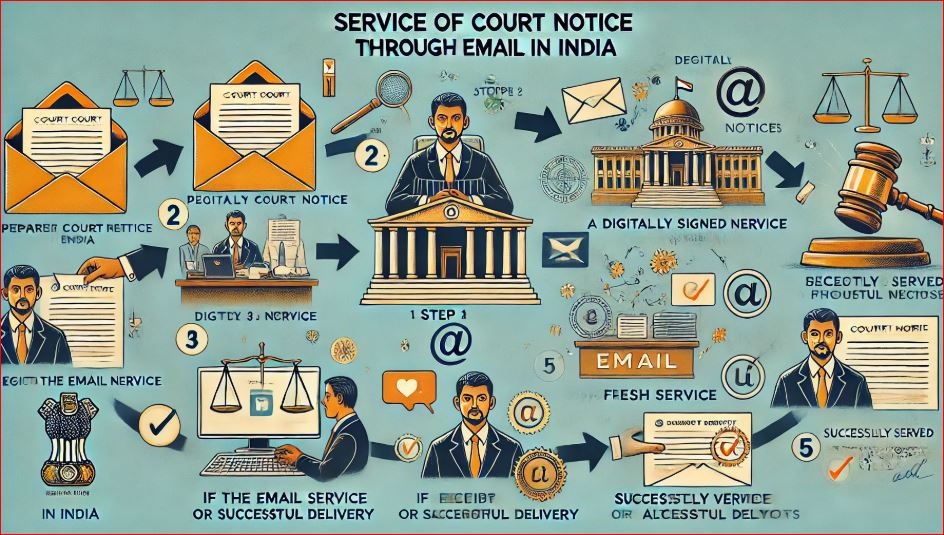
Step-by-Step Procedure.
a. Party provides recipient’s email. b. Party submits supporting documents in PDF format. c. Court Registry processes the request. d. Presiding Judge or Court Official digitally signs the summons. e. E-mail is sent by Nazarat (Process Branch) from an official court email. f. System generates an acknowledgment e-mail g. If the email bounces, a report is sent to the court.
Each case has a designated e-mail folder for:
Summons.
Documents.
Delivery Reports.
E-mail logs are maintained by Nazarat/Process Branch.
Auto-generated acknowledgment and bounced emails are stored separately.
Witnesses can also be served via email.
Includes summons for document production.
Courts can direct any notice to be sent via email.
Must be digitally signed by an authorized officer.
Courts can still use traditional methods if required.
The e-mail rules do not override CPC provisions.
Courts are not liable for delivery failures.
If an email is mistakenly received by the wrong person, they must report it.
Key Takeaways 1. E-mail is now an official legal method for summons and notices. 2. Businesses must accept summons via registered email. 3. Bounced e-mails are invalid; fresh service is required. 4. A minimum fee of ?30 is required for e-mail-based service. 5. Courts maintain records of all e-mail communications.