Why is a regime-change revolution difficult in India?
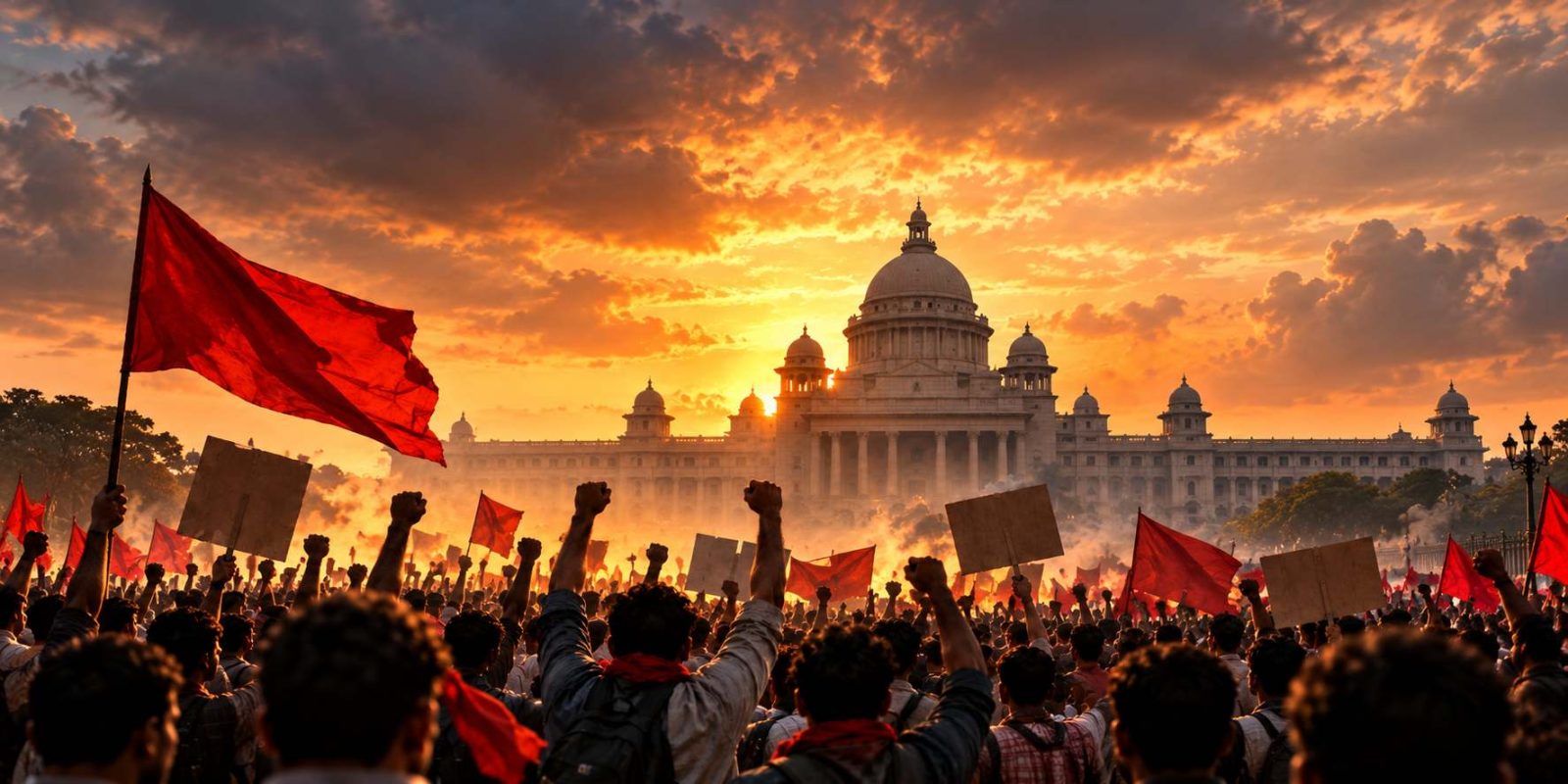
A regime change through a popular revolution is not impossible in India. However, a revolution that completely overturns the existing political, economic and constitutional order is much less likely than a change of government through elections. The central reason is this: India has many mechanisms for expressing public anger and changing political power without overthrowing the system itself. Elections, federalism, caste and regional politics, constitutional institutions, and the sheer diversity of the population make a unified revolutionary movement difficult to sustain. The principal reasons are here.
India is too diverse for a single revolutionary cause
India is divided by language, caste, religion, region, class and local interests. India has thousands of castes and sub-castes, but no authoritative consolidated national figure. Estimates depend on whether sub-castes and regional communities are counted separately. We have six major religions, more than 100 languages, thousands of castes. Each religion and caste has its own leader with enormous amount of ego to mingle with the other leaders. Moreover, the geographical reasons contribute to the failure or any revolution. A farmer in Karnataka, an industrial worker in Maharashtra, a government employee in Delhi and a small trader in Uttar Pradesh may have very different political priorities.
A revolution requires more than widespread dissatisfaction.
It requires millions of people to agree on: What exactly must be overthrown. What system should replace it. Who should lead the movement. How power and resources should be distributed afterwards. Discontent may be widespread, but a common revolutionary objective is much harder to achieve.
Selfish motives of the ‘revolutionists’.
The biggest hurdle for any movement is the bonafides of the leaders. In India, unlike the countries like Egypt or Cuba, leaders lack commitment for a particular cause. For them, ‘regime change’ means ‘get me power’. The best alternative is another worst politician.
Elections provide a constitutional outlet for anger
In a democracy, people can remove a government without overthrowing the state. The defeat of the Congress in 1977, following the Emergency, is a striking example. Voters rejected the ruling party through elections rather than through a revolution. Similarly, governments can lose power in individual states even when the same party remains influential nationally. This makes political change possible without dismantling the constitutional system. The ballot often performs the function that revolution performs in a closed political system.
Caste and identity politics fragment class solidarity
Economic inequality can create the conditions for revolutionary politics. But economic class is not the only basis on which Indians organise politically. Caste, religion, linguistic identity and regional interests often cut across economic class. Two people with similar incomes may support different parties because they have different social identities or political priorities. This makes it difficult to build a unified movement of workers, farmers, the unemployed and the economically disadvantaged around a single programme of structural change.
The Indian state is institutionally resilient
India has a functioning administrative apparatus, police forces, armed forces, courts, an electoral system and governments at both Union and state levels. These institutions can absorb, manage or contain political pressure. Federalism also means that opposition movements can acquire power in state governments rather than having to capture the Union government through extra-constitutional means. The constitutional system is not immune to institutional failure or abuse. But it provides multiple channels through which conflicts can be contested.
The middle class often prefers stability to upheaval.
Revolutions are more likely when substantial sections of society conclude that the existing order cannot deliver justice or improvement. In India, even people who are dissatisfied with corruption, unemployment, inequality or political leadership may fear the consequences of a revolutionary breakdown: economic disruption, violence, loss of livelihoods and uncertainty about the future. The aspiration to improve one's position within the existing system can therefore be stronger than the desire to destroy that system.
Political parties absorb and redirect protest.
A protest movement can begin outside the political system, but established parties may subsequently adopt its demands, provide leadership or channel its energy into elections. This can weaken the momentum for a fundamental transformation. The movement may achieve a change in policy or government without changing the underlying distribution of economic and social power.
There is often no credible alternative to the existing order.
A revolution requires not only opposition to the government but also confidence in what will replace it.
If opposition groups disagree about economic policy, social justice, national identity, federalism and leadership, people may hesitate to support a revolutionary programme. Removing an incumbent government is comparatively straightforward; establishing a stable and legitimate alternative is much harder.
But has India never experienced revolutionary movements?
India has experienced powerful mass movements, although most have not resulted in a complete overthrow of the constitutional system.
JP Movement, 1974–77 A mass movement against corruption and authoritarianism helped create the political conditions Anti-corruption movement, 2011 A broad public mobilisation placed corruption and the demand for a stronger Lokpal at the centre of national politics. It influenced political debate and helped reshape the political landscape, but did not replace the constitutional order.for the defeat of Indira Gandhi's government in 1977. The regime changed, but the constitutional framework survived.
Farmers' movement, 2020–21 A sustained nationwide mobilisation led the Union government to repeal the three contentious farm laws. This demonstrated that organised public pressure can produce major policy reversals without a revolution.
The pattern is important: Indian movements can force governments to retreat, change laws, influence elections and even bring down governments. Their success does not necessarily translate into a social revolution.
The deeper question: Can India have a revolution against the system itself?
Yes, in principle. But three conditions would probably have to converge. A common grievance: Different social groups would have to see their problems as connected to the same structural causes. A credible alternative: The movement would need a convincing programme for economic justice, accountable government and institutional reform. Sustained, broad-based participation: The movement would need support across states, castes, classes and communities, rather than relying on a single region or social group. Even then, a major transformation need not be violent. A peaceful constitutional movement could produce revolutionary changes in land ownership, political accountability, public administration, social equality and the distribution of economic power. There is also an important warning from history: the existence of elections does not guarantee that democracy is healthy. During the Emergency of 1975–77, India experienced severe authoritarian repression before the electorate removed the ruling party in 1977.
Conclusion
The greatest obstacle to revolution in India may not be the absence of public anger. It may be the fragmentation of that anger. People may be deeply dissatisfied with the system but disagree about who is responsible, what must change and which alternative deserves support. Meanwhile, political parties offer opportunities to change the government without fundamentally changing the system. That leads to a distinction worth keeping in mind:
Regime change: One government or ruling party replaces another.
Political revolution: The institutions and rules governing political power are fundamentally transformed.
Social revolution: The underlying distribution of wealth, status and social power changes substantially.
India has repeatedly experienced the first. The second and third are much more difficult.
The real question, therefore, is not whether Indians are angry enough to revolt. It is whether that anger can become a coherent, cross-sectional movement with a credible alternative to the existing order.
S. Basavaraj
Senior Advocate
Bengaluru
raj@dakshalegal.com
?