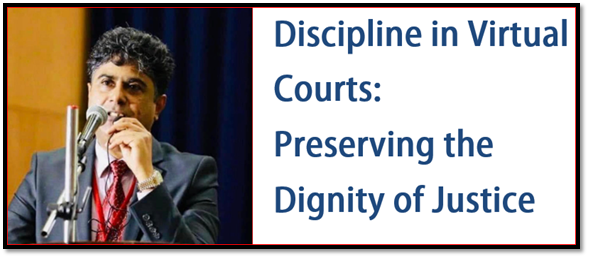
Discipline in Virtual Courts: Preserving the Dignity of Justice.
The Union Cabinet has recently approved Rs. 7,000 crore for Phase III of the e-Courts project, a landmark step towards transforming the Indian judiciary into a digitally empowered institution. The project envisions robust technological infrastructure, paperless courts, and seamless access to justice across the country. Virtual hearings, as part of this initiative, are no longer an emergency measure but an integral component of the justice delivery system.
The Karnataka High Court has already permitted advocates to appear and argue through video conferencing. This facility has brought immense convenience, particularly for lawyers and litigants located far from court premises. It saves travel time, reduces costs, and ensures efficiency.
However, with this new mode of practice comes a responsibility that cannot be overlooked: the maintenance of court decorum in virtual spaces.
Unfortunately, instances have emerged where a few advocates join proceedings from cars, corridors, or other noisy public places using their cellphones. Such appearances compromise not only the quality of advocacy but also the solemnity of court proceedings. A court—whether physical or virtual—remains a place of dignity, where discipline and respect for the institution are paramount.
Advocates are officers of the court. Their role requires them to set a standard of professionalism, ensuring that their participation reflects the seriousness of the judicial process. Just as no lawyer would dare address a physical courtroom while sitting in a corridor or car, the same standard applies to virtual appearances.
It is therefore essential that advocates:
1. Join proceedings from their office, home office, or another professional setting.
2. Ensure a soundproof or decent background free from distractions.
3. Maintain proper attire as they would in a physical courtroom.
4. Use stable internet and appropriate devices to avoid interruptions.
The success of the e-Courts project depends not only on government investment but also on the conduct of its stakeholders. Technology can provide tools, but discipline ensures credibility. Virtual hearings are an opportunity to demonstrate that the legal fraternity can harmonise tradition with modernity, efficiency with dignity.
Please remember, the judiciary, as the guardian of justice, is entrusted with the responsibility of maintaining discipline and decorum within court proceedings. The Supreme Court has held that courts possess inherent power to enforce order and discipline in the courtroom.
While lawyers and litigants enjoy the right to be heard, such rights must be exercised with respect for the institution. No one can claim unrestricted freedom of conduct in a court of law. If advocates or parties act in a manner that disrupts proceedings, shows disrespect, or lowers the dignity of the court, the presiding judge is fully empowered to take corrective measures.
Such power includes stopping video/audio connection to the Advocate if he does not maintain decorum while appearing online.
As the judiciary embraces digital transformation, it is incumbent on advocates to uphold the highest standards of decorum. By doing so, they not only respect the court but also strengthen public faith in justice—whether delivered in a grand courtroom or through the screen of a computer.
S. Basavaraj
Senior Advocate and Member, Karnataka State Bar Council