The Argumentative Judge
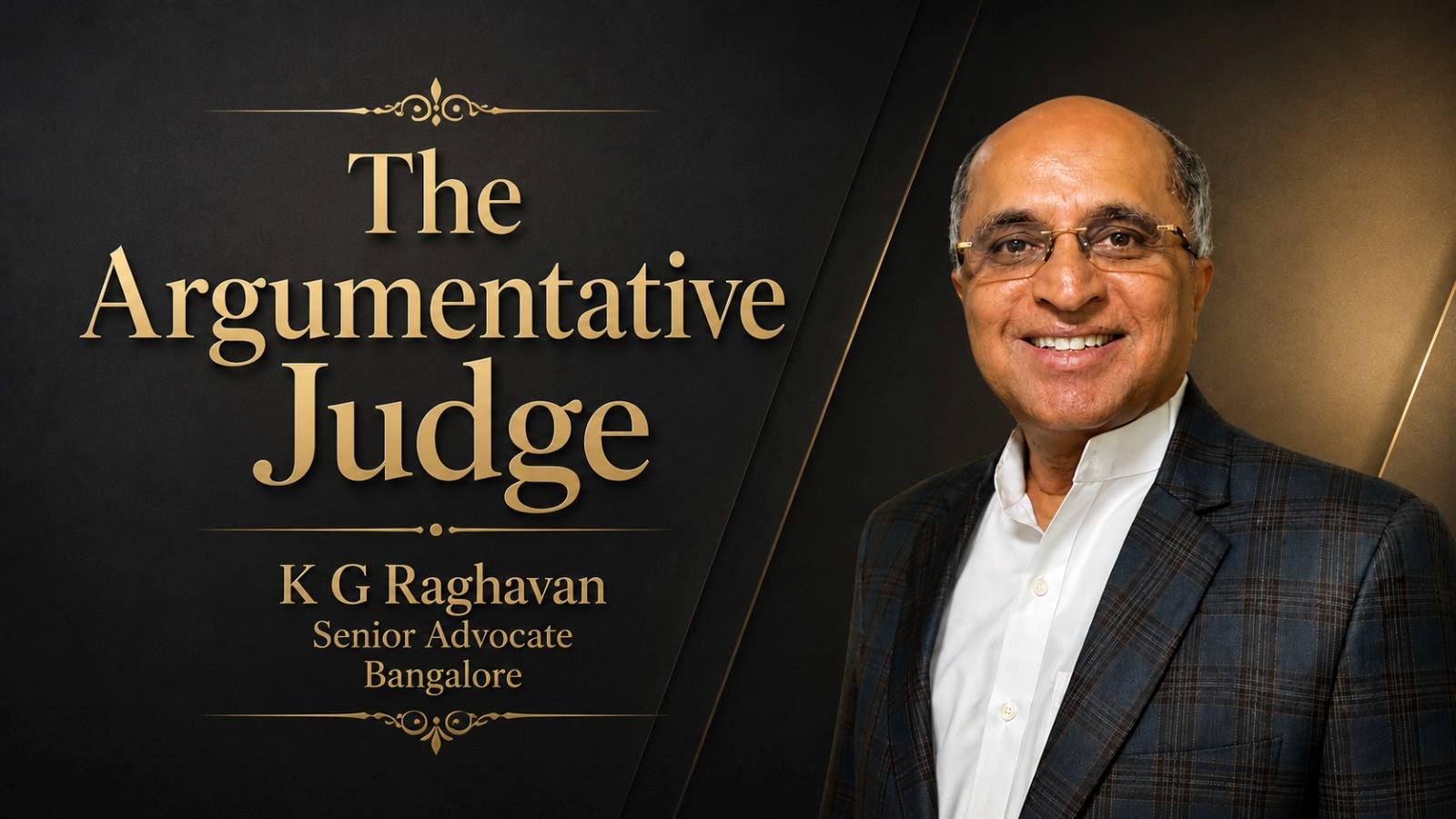
K.G.Raghavan, Senior Advocate, Bengaluru.
Democracy thrives on debate. At times, debates are noisy; at times learned; at times generating more heat than light. Courts are part of the democratic process; nay Courts are founded on democracy. Indeed, democracy without Courts is an oxymoron.
Indian Courts have always been places of live conversation between judges and advocates. This dialogue does more than resolve disputes. The judiciary being a temple of justice shapes jurisprudence and builds public trust, while simultaneously developing society. The judiciary is the beacon of light, striving for societal reform through not just final decisions, but also through judicial deliberation. However, this tradition is now under threat. Social media clips of courtroom remarks, stripped of context, become controversies. Media reporting often dramatizes rather than explains. A particularly dangerous force is the straw man fallacy, where critics distort, exaggerate or misrepresent a judge’s oral observation into something that the judge never said or quote it out of context. They then attack this weakened version of the argument, instead of addressing what the judge actually asked. Lawyers also allege bias whenever a judge speaks candidly and immediately rush to appellate Courts. The result is a chilling effect. Judges grow quieter and justice suffers.
We must ask a difficult question. When judges fall silent, does justice lose its voice?
Critics of judicial deliberation often invoke Francis Bacon’s quote, “A much talking judge is like an ill-tuned cymbal.” But Bacon never wrote those words, in the way it is used today. The original text of his essay, Of Judicature, reads: “an overspeaking judge is no well-tuned cymbal.” This passage is almost always misquoted.
The distinction here matters. Bacon was not condemning judicial speech. He was condemning a specific vice: the judge who interrupts counsel, cuts arguments short, and prevents the advocate from being heard. Bacon describes four duties of a judge in hearing. The judge must direct evidence, moderate length and repetition, recapitulate the material points, and then give the rule or sentence. These are active duties. A well-tuned cymbal does not make noise, it simply makes the right sound. An overspeaking judge may be akin to an ill-tuned cymbal, but a well-tuned cymbal is no silent instrument. It is crucial not to limit the deliberation of the Court through unfair criticism and allegations of bias.
India’s Constitutional Courts are polyvocal. It speaks through many benches, each engaging with the law in real time. A polyvocal Court can be a disciplined Court, and the oral culture of the Indian courtroom is an asset. The judge who genuinely engages with advocates, enriches the law.
A comparative look shows that robust judicial engagement is the international norm, and why engagement serves justice. The United Kingdom Supreme Court holds extended oral hearings lasting days or weeks. Judges probe submissions extensively, a form of dialogue that does not threaten judicial independence, but enriches it. The adversarial system is often misunderstood. Some think it requires a passive judge who merely umpires. That is wrong. Truth emerges from the contest of arguments before an impartial adjudicator. But impartial does not mean silent. Section 168 of the Bharatiya Sakshya Adhiniyam expressly empowers judges to ask questions at any stage to discover the truth. Stanley M. Clark, in his work Gentlemen, Their Lordships, captured a distinctive feature of British practice. He observed that there is at times a lively discussion between counsel and the lords. The British bench and bar use analogies and comparisons as a means to test the reasoning and the sweep of prior decisions. Clark contrasted this with American Courts. He wrote that the method of argument and reasoning by analogy is rarely used by American lawyers and Courts. But it is one of the distinctive features of oral argument in the British Courts, and counsel and judges alike are skilled in and obviously believe in the value of this technique of logic and argument. Engagement thus serves justice.
Consider Maneka Gandhi’s case. The Supreme Court held that the right to be heard under Article 21 must be genuine, not an empty formality. To be heard requires an active listener and a silent judge does not truly hear. Where judges are mere spectators to the proceedings, it would constitute an empty formality and serve no purpose.
“The audi alteram partem rule is not cast in a rigid mould and judicial decisions establish that it may suffer situational modifications. The core of it must, however, remain that the person affected must have a reasonable opportunity of being heard and the hearing must be a genuine hearing and not an empty public relations exercise.”
The initial mentions of the principles of natural justice originated in ancient Greek and Roman cultures. Audi alteram partem means to “hear the other side”. But what is the real meaning of “hearing the other side”? Is it simply to be heard by the judge, or is it the opportunity to convince the judge of your case?
The idea of audi alteram partem as a rule of natural justice goes back to the late Latin fathers of the Church. Tertullian in Apologeticus wrote that there is open opportunity to reply and debate as it is not lawful to condemn in any way the undefended and the unheard. The ancient Athenian statesman, Solon, observed that human beings enjoy hearing an accusation more than a defence, and therefore realised that a defendant, speaking after his accuser, could only be protected from an incorrect judgement if the judge showed an equal degree of attention to both parties. It is said that even God himself did not pass a sentence upon Adam before he was called upon to make his defence.
It was in this background that the concept of audi alteram partem evolved. It means that a fair opportunity must be given to each person to voice their opinions before a decision is made and to convince the judge of their case. The question then arises: how can one ensure that the judge is convinced of their case? It is simply through argumentation. Argumentation is an important way to reach new understanding. A judge cannot be convinced of an argument through mere spectatorship. It requires judges to reason and ask relevant questions, clarify arguments, uncover the truth, and ensure a fair trial. Many a time, judges play the role of the devil’s advocate with the aim of soliciting responses which aid the case and strengthen the arguments before them.
Reacting to various personal attacks against Justice Suryakant and himself on social media, in the Nupur Sharma case, Justice Pardiwala observed:
“Personal attacks on judges for their judgments lead to a dangerous scenario where the judges have to think about what media thinks instead of what the law really thinks. This harms the rule of law. Social and digital media is primarily resorted to expressing personalised opinions more against the judges, rather than a constructive critical appraisal of their judgments. This is what is harming the judicial institution and lowering its dignity. The remedy of judgments does not lie with social media but with higher courts in the hierarchy. Judges never speak through their tongue, only through their judgments.”
Courts themselves have recognized that excessive public scrutiny and criticism may inhibit judges from speaking their mind. Judges must remain free to deliberate, question and express tentative views without fear of personal attacks and reproach.
The Supreme Court in the case The Chief Election Commissioner of India v. M.R. Vijayabhaskar taking note of the casual remarks made by the Chief Justice of the Madras High Court, Justice Sanjib Banerjee observed that oral arguments are postulated on an open exchange of ideas. It is through such an exchange that legal arguments are tested and analysed. Justice Chandrachud further observed that oral remarks made by the Bench during a hearing not only provide clarity to the judges adjudicating upon the matter, but also assist lawyers in developing their arguments creatively and spontaneously. Revealing the mind of the judge helps lawyers persuade the Court of their case. The Supreme Court held that, in the pursuit of justice, propositions may be put forth and observations made in order to facilitate the process of arriving at an acceptable outcome based on law. Most importantly, the Court held that observations made during the course of a hearing do not constitute a binding decision, but are merely tentative points of view on which rival perspectives of the parties enable the judge to consider all viewpoints and formulations before evolving a solution that accords justice in accordance with law.
The Court further held that oral remarks do not form part of the official judicial record and, therefore, the question of expunging them never arises. The formal opinion of the Court is reflected through its judgments and orders, not through oral observations made during the hearing.
Public confidence is the lifeblood of the judicial system. Without it, the judiciary would cease to hold any legitimacy or authority. The casual and often irresponsible extrapolation of judges’ oral observations, particularly those that do not form part of the official record and do not represent the final view of the Court, diminishes that confidence and, with it, the independence of the judiciary. At a time when public discourse is increasingly driven by noise, instantaneous reactions and selective narratives, responsible reporting, and restraint on the part of higher Courts as to the proceedings in the Courts subordinate to it are essential to ensure that judges remain free to deliberate without fear, and that the judiciary continues to function as an independent institution committed to the administration of justice. Various Courts and judges in India and across the world have affirmed this proposition.
In CEC v. Vijayabhaskar, the Supreme Court emphasised the need to preserve the independence of the judiciary and to allow freedom of expression to judges. In the English Court in Sirros v. Moore, Lord Denning observed that every judge must be able to do their work in complete independence and free from fear. Judges should not have to turn the pages of their books with trembling fingers, wondering whether their actions shall make them liable for damages. Judges are not to be plagued with allegations of malice, ill will, or bias. As long as a judge is acting judicially, nothing can make the judge liable, legally or in public eye or perception. This preserves the independence of the judiciary. In Dr Raghubir Saran v. State of Bihar, a three-judge Bench of the Hon’ble Supreme Court noted that the phraseology and remarks made by judges entirely depend on their inherent reaction to falsehood, their command over the English language, and the felicity of their expression. Most importantly, the Court observed that there is nothing more deleterious to the discharge of judicial functions than creating in the mind of a judge the notion that he is to conform to some prescribed pattern. An unmerited and undeserved remark by a judge may have to be tolerated in the larger interest of preserving the independence of the judiciary. In other words, judges and their speeches should not be put in a straitjacket formula and be subjected to microscopic scrutiny. They should enjoy free play in the joints. Trust the judges not to misuse the free play.
This is not applicable only to the media, but also to appellate Courts. Appellate Courts must strike a balance between unnecessarily reproaching lower Courts, thereby hampering their independent functioning, and intervening where judges have acted beyond their mark and breached the norms of judicial discipline. As noted by Lord Denning, judges should not be in constant fear of higher Courts making strong observations against them merely for speaking their minds, which may often be in jest or on a lighter note.
Remarks of a judge in Court could be occasioned by his or her reasonable and righteous indignation on the facts of the case before the Court. It is as it should be. A righteous human being should frown unhesitatingly on the wrong and not grudgingly. This is the rule of Dharma. In fact, it is said to be the quality of Lord Rama himself.
“Illustrious and noble persons become firm like the ‘vajra’, the weapon of God Indra and very gentle like a flower, depending upon the prevailing situation. They are illustrious because of this special trait”
Ultimately, effective dispensation of justice necessarily contemplates an active exchange between the bar and the bench where arguments are tested and scrutinized. Judges cannot be expected to discharge their functions through passive spectatorship, nor can lawyers persuade the Courts in the absence of judicial deliberations. Even casual remarks form an integral and an inextricable part of the deliberative process, which eventually results in a robust legal system and a continued evolution of jurisprudence. Treating every such observation critically or as evidence of bias or being extraneous and therefore, unnecessary, inevitably puts a huge burden on the shoulder of judges. If judges are compelled to speak with excessive caution for fear of criticism or reproach from higher Courts, the result would be a chilling effect. This result would diminish the value and the efficacy of the process through which Courts arrive at just and reasoned decisions. A judiciary that is free to question, remark and think aloud is indispensable to the effective administration of justice.
The ultimate object of a Court system is not simply to decide a lis between the two litigating parties. The effort is in search of justice. Justice requires to be unravelled, as it is invariably buried in a conundrum of facts, some true, some contrived. The attempt is to sift the grain from the chaff and in most cases, it is as difficult as to search for a needle in a haystack.
Healthy debate helps in growth of law. Some portions of that debate may not be necessary for the disposal of the particular lis, but the role of the Courts, especially the superior ones, is not simply to decide the lis, but to contribute to the growth of jurisprudence.
These can happen only where there is a healthy debate between a judge, who is surfeit with experience and counsels who have specialized knowledge in a particular branch of law. Do we want a silent, mute court proceeding with lawyers not being able to understand the mind of the judge and aid the judge in the decision-making process? Do we want judges to simply retire from Court without understanding the nuances of the case and attempting to clarify their doubts, thereby depriving themselves of the ability to write a reasoned and just judgment? The answer is obvious in the question. We would prefer the noise and hustle-bustle of a city, rather than the silence of the graveyard.
Senior Advocate K.G. Raghavan.
Assisted by, Priyanka Ajjannavar, Advocate.
Smaran Maletira (Third Year, Jindal Global Law School).
S Venkat Raghav (Fourth Year, Manipal Law School).
References
1. Francis Bacon, Of Judicature, 9 LITIG. 64 (1983).
2. Stanley M. Clark, Gentlemen, Their Lordships, 62 A.B.A. J. 1440, 1443 (1976).
3. Bharatiya Sakshya Adhiniyam, 2023, No. 47, Acts of Parliament, 2023 (India).
4. Maneka Gandhi v. Union of India, (1978) 1 SCC 248.
5. Chief Election Comm’r of India v. M.R. Vijayabhaskar, AIR 2021 SC 2238.
6. Dr. Raghubir Sharan v. State of Bihar, AIR 1964 SC 1.
7. Cooper v. Wandsworth Board of Works, (1863) 14 CB (NS) 180.
8. John M. Kelly, Audi Alteram Partem;Note, Natural Law Forum, Paper 84 (1964).
9. M Fisher, The illusion of argument justification, 143, J Exp Psychol Gen 425, (2014).
10. Tanaya Moholkar, Principles of Natural Justice, Legal Journey.
11. V. Venkatesan, Off the cuff, Supreme Court Observer.
12. Sirros v. Moore, [1975] QB 118.
13. Mark A. Neubauer, The Disappearing Oral Argument, Carlton Fields.
14. Mohan Chandra Joshi, Sanksrit Subhashitas, 12 April 2015.
15. Ananditya Sanyal, Supreme Court Judge Who Heard Nupur Sharma Plea Slams “Personal Attacks”, NDTV, 04 July 2022.