Karnataka Civil Courts (Amendment) Act. All Regular First Appeals filed and pending before the High Court on or after 28 August 2007 to be transferred to the subordinate Courts. Judgements already rendered and orders passed in such cases are held valid. Karnataka High Court.
Smt. Narayanamma v. State of Karnataka
Connected with: Babu Rao & Anr. v. State of Karnataka
Case Nos.: W.P. No. 17588/2024 c/w W.A. No. 200260/2025
Court: High Court of Karnataka, Bengaluru
Date: 8 July 2026
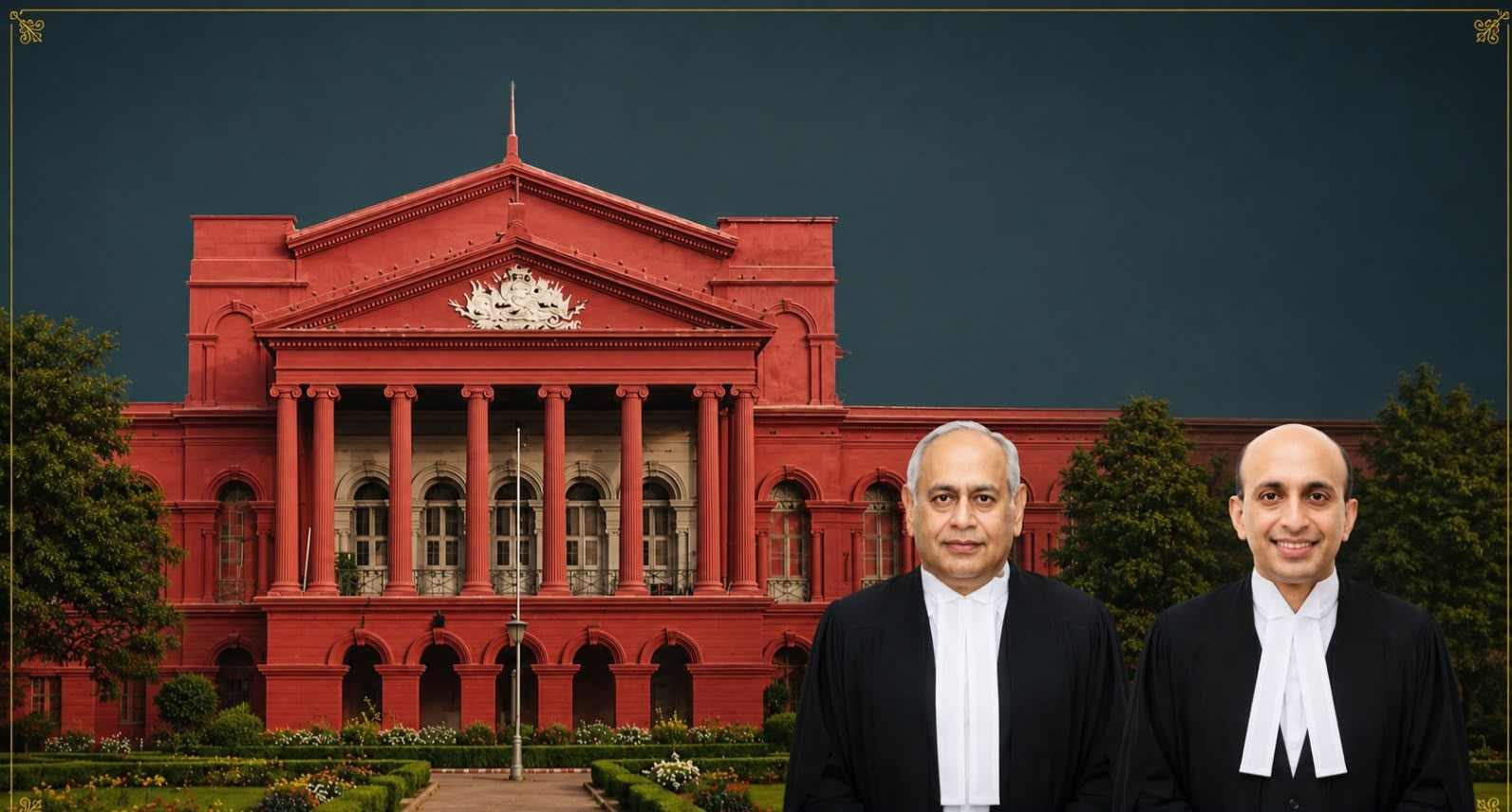
Bench: Hon’ble Mr. Justice Vibhu Bakhru, Chief Justice and Hon’ble Mr. Justice C.M. Poonacha
Author: Chief Justice Vibhu Bakhru
IMPORTANT PARAGRAPHS. 1. The Appellants have filed the present appeal (W.A.No.200260/2025) impugning the judgment dated 24.09.2025 [‘impugned order’] passed by the learned Single Judge of this Court in W.P.No.201536/2024 (GM-RES). Appellant No.2 is similarly aggrieved. His appeal, RFA No.200009/2025, arising from the judgment and decree dated 27.09.2024 passed by the learned Senior Civil Judge & JMFC, Sedam in O.S.No.49/2018, is stated to be pending before the Kalaburagi Bench of this Court. He was impleaded in the present appeal by an order dated 30.10.2025.
2. The Appellants and Writ Petitioner have filed their respective appeal and petition, inter alia, praying that the Karnataka Civil Courts (Amendment) Act, 2023 [‘Civil Courts Amendment Act’] and the Karnataka High Court (Amendment) Act, 2023 [‘High Court Amendment Act’] be declared as ultra vires the Constitution of India. The Civil Courts Amendment Act and the High Court Amendment Act are collectively referred to as ‘the impugned legislations’.
08. The controversy, thus, narrows down considerably to whether the judgments and orders passed in appeals prior to the enactment of the impugned legislations are saved, absent any savings provision. According to the learned Senior Counsels appearing for the Appellants/Petitioner, the absence of a savings clause in the Civil Courts Amendment Act is a fatal error in drafting, which is incurable. According to them, the literal interpretation of the impugned legislations leaves no scope for reading in a savings provision.
109. We are unable to concur with the aforesaid contention. It is well settled that a legislative enactment must be presumed to be constitutionally valid. Thus, the Courts must choose an interpretation that sustains the legislation’s validity rather than one that renders it invalid. To that end, the Courts will, where possible, read down a provision to preserve its validity.
115. We find no difficulty in reading down Section 4 of the Civil Courts Amendment Act so as to exclude from its retrospective operation (i) all appeals that stand concluded by final judgments and orders; and (ii) all orders passed in proceedings that are pending. The retrospective operation of the amendments is thus confined to pending appellate proceedings, which shall be governed by the amended provisions from the current stage till the disposal of the appeals. This is in conformity with the legislative intent, as is unmistakably discernible from (i) the rationale for enacting the impugned legislations; (ii) the opinion of the Karnataka Law Commission; and (iii) the Statement of Objects and Reasons of the impugned legislations. Consequently, the pending proceedings will continue from the stage at which they are transferred to the competent court. The proceedings already conducted prior to the enactment of the impugned legislations and as continued by virtue of the interim order dated 03.07.2024, passed by this court, shall not be construed as non-est, illegal or a nullity.
120. The learned Single Judge held that the retrospective effect given to the amendments under the Civil Courts Amendment Act had to be regarded as a mistake on the part of the legislature and was arbitrary and unreasonable, leading to confusion and absurdity, as well as being repugnant to other provisions of the Act.
121. We concur with the conclusions of the learned Single Judge in the impugned order, except to the extent that the retrospective effect given to the amendments under Section 4 of the Civil Courts Amendment Act has been set aside. In our view, the said provision is required to be read down, as indicated above, to exclude the concluded matters as well as the orders passed in the pending proceedings from its retrospective operation. The impugned order is modified to the aforesaid extent.
122. We also concur with the consequential directions issued by the learned Single Judge for the implementation of the impugned legislations. The impugned legislations were stayed, and therefore the matters were not transferred to the competent courts. Thus, it is also necessary to direct that further proceedings shall be undertaken from the stage as of the date of transfer, and all judgments and orders passed prior to the said date are saved.
SUMMARY. AI generated.
Background. The challenge was to the Karnataka Civil Courts (Amendment) Act, 2023 and the Karnataka High Court (Amendment) Act, 2023. By these amendments, first appeals arising from decrees and orders of Senior Civil Judges were directed to lie before the District Court, irrespective of pecuniary value, instead of the High Court. The amendments also sought to operate retrospectively from 28.08.2007.
The petitioners contended that the amendments were unconstitutional because they deprived litigants of a vested right to have their appeals heard by the High Court, were retrospective without a proper saving clause, lacked prior consultation with the High Court, and were discriminatory as appeals from Bengaluru City Civil Courts would still lie to the High Court.
Main Issues
The Court considered whether:
- The State Legislature had competence to alter the appellate forum.
- Prior consultation with the High Court was mandatory.
- The change of appellate forum affected vested rights.
- The retrospective operation from 28.08.2007 was valid.
- Concluded High Court judgments would become invalid.
- The distinction between district Senior Civil Judge appeals and Bengaluru City Civil Court appeals violated Article 14.
Findings
The Court held that the State Legislature was competent to enact laws concerning civil courts, appellate jurisdiction, and administration of justice. The Court observed that constitutional courts cannot strike down legislation merely because they doubt its wisdom or effectiveness. Judicial review is confined to lack of legislative competence, violation of constitutional provisions, or manifest arbitrariness.
On consultation, the Court held that though consultation with the High Court would have been desirable, there was no express constitutional or statutory mandate requiring such consultation before enacting these amendments. Therefore, absence of consultation did not invalidate the legislation.
The most important finding was on forum of appeal. The Court held that while the right of appeal is a substantive statutory right, the forum where the appeal is heard is procedural. Therefore, a change in appellate forum can apply to pending appeals unless the statute indicates a contrary intention.
The Court rejected the argument that litigants had a vested right to insist that their first appeal must continue before the High Court. It held that no party has a vested right in a particular appellate forum when the legislature validly changes the forum.
On retrospectivity, the Court held that the amendment could not be interpreted to nullify concluded judgments already rendered by the High Court. The Court noted that it was common ground that concluded appeals could not be reopened and that the legislative intent was not to render past judgments void.
Therefore, the retrospective provision was construed purposively to apply only to pending matters and not to concluded proceedings.
On discrimination, the Court rejected the Article 14 challenge. It held that there is a reasonable distinction between Senior Civil Judges functioning in districts and City Civil Judges in Bengaluru, who are in the cadre of District Judges. Hence, appeals from Bengaluru City Civil Courts continuing before the High Court did not make the amendment discriminatory.
Final Result
The Division Bench upheld the constitutional validity of both the Karnataka Civil Courts Amendment Act and the Karnataka High Court Amendment Act. Pending first appeals from Senior Civil Judges are to be transferred to the jurisdictional District Courts. However, judgments already delivered under the unamended law remain valid and cannot be reopened.
Very Brief Legal Principle
Change of appellate forum is procedural and can apply to pending appeals; however, retrospective legislation cannot be construed to invalidate concluded judgments unless such intent is clear and constitutionally permissible.
HELD
Karnataka Civil Courts (Amendment) Act. All Regular First Appeals filed and pending before the High Court on or after 28 August 2007 to be transferred to the subordinate Courts. Judgements already rendered and orders passed in such cases are held valid. Karnataka High Court.