Third Party Funding of Litigation
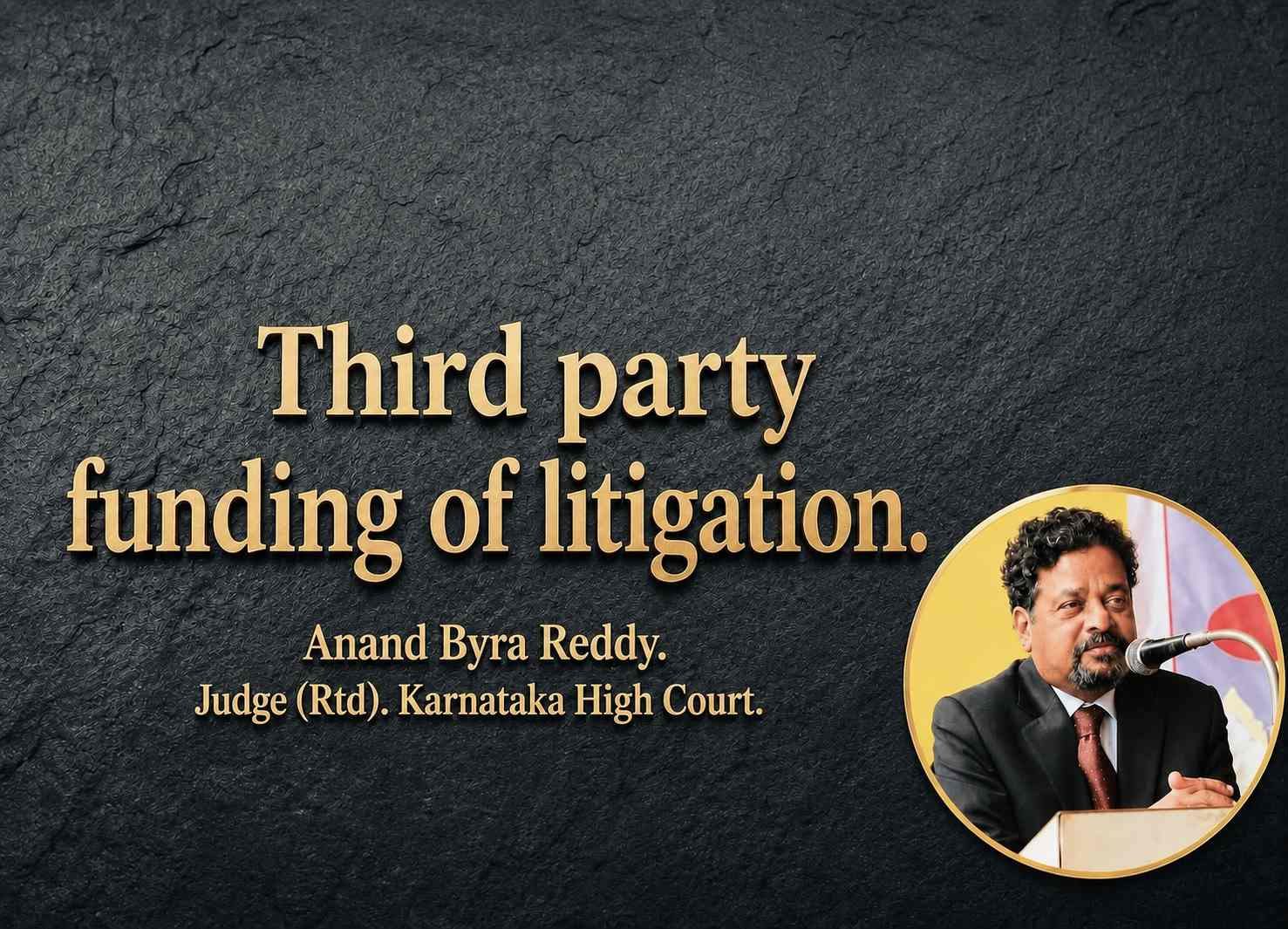
Anand Byra Reddy. Judge (Rtd). High Court of Karnataka.
'Maintenance', is generally defined as the act of providing funds to a partyto a dispute - but where the 'funder' has no prior interests involved therein; But does so, on the basis that he receives a share of the reward, on a final outcome of the proceedings.
'Champerty', is a variant of maintenance - it is the provision of the same assistance, but where the 'maintainer' agrees to provide funding - on the basis that he gets a share of the proceeds of such action, or proceedings, if the litigant were to succeed.
It is common knowledge that 'maintenance and champerty', were outlawed in many jurisdictions, as being a civil wrong, or a tort for over two centuries.
However, many jurisdictions such as the United Kingdom, the USA, Australia Singapore and Hong Kong have legalized third- party funding, in one way or the other. It was surprising to learn that the United States of America has permitted third party funding for over a century, where something called 'contingency fee arrangements' - has been in vogue and has created sections of lawyers derogatorily, labelled as 'ambulanc?chasers'.
But today, the usefulness of these doctrines has been reconsidered in the light of advanced legal safeguards against fraud and abuse which are now in place. It is particularly to be stated that Singapore - which is poised to be the world leader in Arbitration law - is setting the positive trend. Its Parliament amended its Civil Law in the year 2017 and further forged ahead in the year 2021, to include domestic arbitration in the process, whereby the common law tort of maintenance and champerty were abolished. It was also made clear that a contract for third-party funding of international arbitration proceedings - along with any related court proceedings or mediation proceedings - would not be rendered unenforceable as being contrary to public policy or being illegal.
International arbitration is indeed expensive (not that domestic arbitrations are any less expensive) and hence, it deters parties with legitimate claims- from commencing any proceedings. This has led to an increase in demands for financing options for dispute resolution. Third-party funding has become a feature in most of the seats of international arbitration, such as London, Paris, Singapore, Hong Kong, Geneva etc.
Though some countries have permitted third party funding and have even regulated the same, internationally there is a lack of consistent regulations. Third party funding has not gained traction in India. Though such funding may not be illegal in India. In one case decided by the Supreme Court of India in, - Bar Council of India v. A.K. Balaji (2018) 5 SCC 379, it was made clear that lawyers in India could not fund litigation on behalf of their clients, it did not discount the possibility of third parties funding litigation.
It is to be noted that even earlier to the above decision, it had been held that the doctrines of maintenance and champerty were inapplicable in India, as with the coming into force of the Indian Contract Act, 1872, which did not follow the English law rule against those above doctrines and champertous arrangements were not per se void in India. In the case of Raja Rai Dayal Singh v. Debi Dayal Sahu, (1908) UKPC 2, the Privy Council held that an agreement that may be champertous under English law is not void in India, unless it was against public policy. This legal position came to be consistently followed in India in a spate of decisions over the years. [Refer- Malhotra- Commentary on the Law of Arbitration (Fourth Edition) By Justice Indu Malhotra - Volume Il page 1539.]
Further, in the case of In Re. Mr. 'G', A Senior Advocate of the Supreme Court of India, AIR 1954 SC 557, the Hon. Court considered a conditional fee arrangement between the Senior Advocate and a litigant, it was held the rigid English rules of champerty and maintenance did not apply in India, though the Court did find the contract objectionable because of the involvement of counsel having entered into a conditional fee arrangement; It was however, made plain that such agreements were not morally wrong, nor do they shock the conscience, nor was against public policy and morals, in such transactions per se, if a legal practitioner were not involved.
The future. The Srikrishna Committee which was constituted to Review the Institutionalisation of Arbitration Mechanism in India (2017), has commented on the benefits of legalizing third party funding as follows:
"Apart from arbitration legislation, in certain jurisdictions, the enactment of supporting legislation has contributed significantly towards the growth of these jurisdictions as arbitration hubs. For instance, Singapore has recently passed amendments to its Civil Law Act legalizing third party funding for arbitrations and mediations. The Paris Bar Council has also indicated its support for third party funding"
Refer: Malhotra - Commentary on the Law of Arbitration - Fourth Edition (supra) page 1541 and it is further commented on page 1542, as follows:
"The observations of the Srikrishna Committee and the comments made by the Supreme Court in A.K. Balaji suggest that the time is ripe to introduce regulations to formalize third party funding in India by way of appropriate amendments to the Indian Arbitration Act or by independent regulations. The introduction of regulations governing third party funding in arbitration in India would be consistent with practices in otherjurisdictions of the world, such as Singapore and Hong Kong where such legislation has been introduced/amended to permit third party funding."