Rest My Case
How often have we not heard counsels tell the court, “My lord, the point is simple, and my submissions will be brief.” His Lordship accepts it not with a pinch of salt but with a ton of salt.
This is the hymn every advocate begins with, and the one that is almost met with prompt betrayal. The irony of a “brief” submission is the exploitation of the word that is rarely honoured. It is often misconceived that the length of the argument is proportionate to the winning rate. But if all considerations are taken into account, it is quite the opposite. Mr. Fali S. Nariman has rightly examined this issue, and his words of wisdom need to be recalled - "When an advocate speaks, he has to think about what he is going to say and say it precisely and with brevity. I have always noticed, the man who speaks less generally win."
What the court demands is precise submissions and the ability to communicate with the Bench. A sentence too many could jeopardise the entire client’s case. There is no room for repetition in court. What is important is not who says, but what is said. A short, brief and well-thought-out submission of a junior member of the bar is as important and potent, if not more, than an elaborate, convoluted argument of a senior member of the bar. When a point is established, and the court is accepting the same, continuing to circle the same point would not in any way strengthen the stance; instead, it would lessen the significance of the position. Piling words would not only be unnecessary but might turn the dagger against oneself. How often have we not encountered in courts a situation where a Judge is posing uncomfortable questions to the counsel of the opposite side, and the other counsel stands up and makes a submission which invites a hostile reaction to the case itself from the judge. A much-speaking lawyer is a bad advocate. It is more important to know what not to say, how much to say and when to stop than verbose advocacy. One should remember the subtle but vital distinction between the immortality of speech and the eternity of speech.
Lengthy submissions weaken the bench’s engagement. Complex matters are to be put out effortlessly, or in the words of Justice Kantilal Desai, "The art of advocacy: to make simple what is complicated and not vice versa!"[i] Multiplying grounds or presenting numerous submissions dilutes the argument and deviates from clarity. They make the stance even worse. This lesson was delivered to one such young lawyer, Jang Bahadur. Early in his practice, he had filed an application for review in a second appeal decided by Sir John Stanley and Sir William Burkitt. He stood before the bench to make his submissions when Sir John intervened and asked: “My dear boy, how many grounds have you taken?" "Seven, my lord" fumbled Mr. Jang Bahadur. Sir John paused for a second and replied: "You don't mean to say that we have committed seven mistakes in deciding this small second appeal." The court erupted in laughter. This instance is recorded in “Law and Laughter”[ii], a compilation made by Justice Gyanendra Kumar (Allahabad High Court). Seven grounds for a simple second appeal. This occurrence marks the need not to pile ground upon ground but instead to refrain from doing so. There is yet another classic instance of misuse of pleadings. We are all aware that an award passed by an arbitral tribunal can be challenged on limited grounds under the Arbitration and Conciliation Act, 1996. It is not an appeal. Lamenting the approach of the bar in challenge to award proceeding, the Hon’ble Supreme Court in the case of Bombay Slum Redevelopment Corporation Pvt Limited v. Samir Narain Bhojwani[iii] observed:
“35. By way of illustration, we are referring to the factual aspects of the present case. The award runs into 139 pages. The petition under Section 34 of the Arbitration Act runs into 93 pages and incorporates 151 grounds. The judgment of the learned Single Judge dealing with the petition under Section 34 consists of 101 pages. One of the contributing factors is that more than 35 decisions were relied upon by the parties before the learned Single Judge. On the same point, multiple judgments have been cited, taking similar views. As per the practice in the High Court of Judicature at Bombay, a memorandum of appeal under Section 37 of the Arbitration Act does not contain the facts but only the grounds of challenge. In the memorandum of appeal preferred by the respondent consisting of 46 pages, 164 grounds have been incorporated. Considering the narrow scope of interference under Sections 34 and 37 of the Arbitration Act, we cannot comprehend how there could be 151 grounds in a petition under Sections 34 and 164 grounds in an appeal under Section 37. It is not surprising that this appeal has a synopsis running into 45 pages, and it contains as many as 54 grounds of challenge.
36. ……The time of our Courts is precious, considering the huge pendency.”
In the Article 370 case, oral arguments spread over 16 days for 60-plus hours. In the Ayodhya Case, oral arguments stretched to over 200-plus hours spread over 40 days. In the Sabarimala Review case, arguments were heard for over 40-plus hours with 56 arguing counsels. With the burgeoning burden of pendency of cases in court, the glaring question is, “Can the Indian judiciary and justice dispensation system in this country afford this extravagance?”
We are familiar with the practice in the US Supreme Court that oral arguments are time-sensitive. In the 99th Report of the Law Commission (April 1984), headed by Justice K.K. Mathew, titled “Oral and Written Arguments In The Higher Courts”[iv], the question as to whether oral argument has to be limited in time has been examined. It sparked a debate, pro and con. The conclusion was that oral arguments were to be confined to a “reasonable time”. Resistance to restricting oral arguments by time emerged mostly from the Bar, founded on the principle of the right to be heard. The concept of the right to be heard is like the principle of natural justice, “unruly horse”[v].
Over time, the indulgence to counsels proved to be so burdensome to the courts that it couldn’t be tolerated quietly. The 230th Law Commission, headed by Justice AR. Lakshmanan (Former Judge, Supreme Court of India) recommended that “The length of the oral argument in any case should not exceed one hour and thirty minutes, unless the case involves complicated questions of law or interpretation of the Constitution.”[vi]
On December 11, 2025, while hearing petitions challenging Special Intensive Revision (SIR), Chief Justice Suryakant remarked with justifiable anguish[vii]:
“From January 2026, I will not permit these endless hearings in cases. All the Counsels will have to give in writing a commitment to meet the scheduled time-frame. On December 12, 2025, he elaborated on the "human cost" of lengthy arguments citing the example of a widow who waited 23 years for railway accident compensation. He remarked that it was "absolutely unfair and unjustified" for bail or motor accident cases to be pushed aside because of "unending arguments" in high-profile matters. In the Pre-SOP Briefing, the CJI reiterated that establishing "predictable timelines for case disposal" and a "unified national judicial policy" were his foremost priorities. He emphasized that no section of the Bar could claim "privileged access" to judicial time.”
A suggestion of a new Standard Operating Procedure (SOP) was made, which mandates every counsel to stick to the fixed time-frames in writing to prioritise efficiency. This step demands a change in mindset amongst lawyers and in the art of advocacy.
The postscript to the judgement in the case of Ajit Mohan v. Legislative Assembly, National Capital Territory of Delhi[viii], said
“The saga of the hearing lasted 26 hours – which is a lot of judicial time. Daily time period was recorded. Apart from pleadings, there were written synopses, additional written synopses, rejoinders and replies filed liberally by both parties. The convenience compilations themselves were very voluminous, in contradiction to their very purpose. What is the way forward? We do believe that there needs to be clarity in the thought process on what is to be addressed before the Court. Counsels must be clear on the contours of their submissions from the very inception of the arguments. This should be submitted as a brief synopsis by both sides and then strictly adhered to. Much as the legal fraternity would not want, restriction of time period for oral submissions is an aspect which must be brought into force. We really doubt whether any judicial forum anywhere in the world would allow such time periods to be taken for oral submissions and these be further supplemented by written synopsis thereafter. Instead of restricting oral arguments it has become a competing arena of who gets to argue for the longest time.”
Reference was made to Article 6 of the European Convention on Human Rights in support of the position that oral arguments must be concluded in a reasonable time. The court also drew a parallel to the case of R. v. Erskine; R. v. Williams[ix], where it was observed that “If it is not necessary to refer to a previous decision of the court, it is necessary not to refer to it. Similarly, if it is not necessary to include a previous decision in the bundle of authorities, it is necessary to exclude it. That approach will be rigidly enforced.” By referring to this line, the bench opined that there exist a dozen judgments on a proposition of law. And unless disputed by the court, the need for precedents does not exist. And when doubt does arise, the citation must be in relation to the proposition and must not refer to multiple judgements.
Silence as a virtue:
“Words” are the fundamental unit of the lawyer's profession. They make or break the case. Eloquence is considered one of the most celebrated attributes in a good lawyer, often masking the virtue of silence. Silence is not a sign of weakness; it is strength in some situations and strategy in others. It is the catalyst that binds the arguments. A pitcher that is full of water does not generate sound; it is only a half-filled one that makes a loud noise. Similarly, truly learned persons are not boastful and talkative.
Silence arrests the audience’s attention. Mark Twain said, “The right word may be effective, but no word was ever as effective as a rightly timed pause.”[x]
Silent Eloquence[xi] is an indispensable part of invincible advocacy. One of the seven lamps of advocacy is eloquence.[xii] Eloquence is not to be equated with being vocal. Being silent is as vocal as being vocal. A good advocate must know how to make silence speak. Silence can be more eloquent than eloquence itself.[xiii]
“I rest my case” are the golden words from the mouth of an arguing counsel eagerly awaited by the judge.
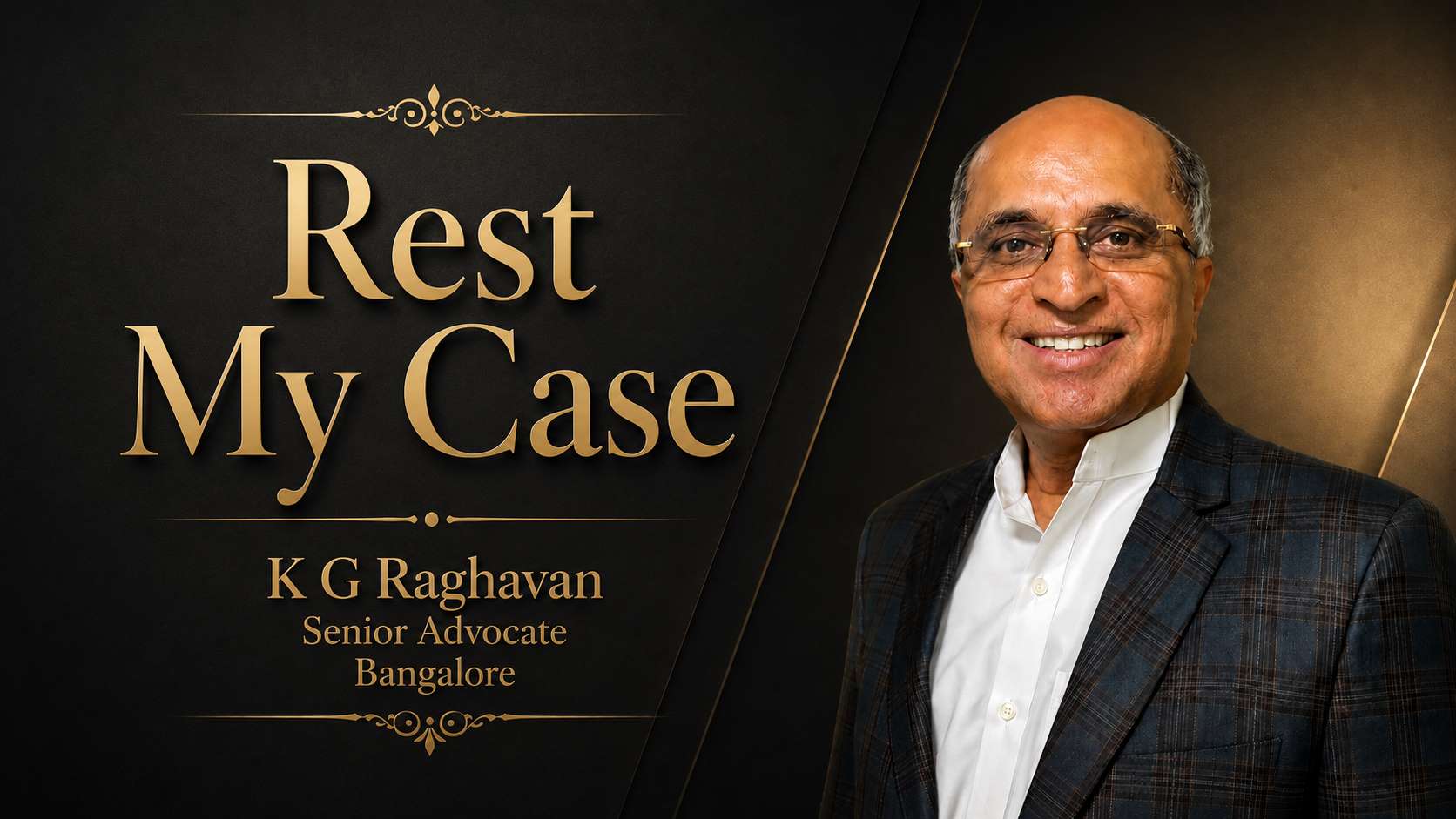
By Senior Advocate K.G. Raghavan
Assisted by, Priyanka A, Advocate
Srinithi Pothiraj (Fifth Year, BBA. LLB SASTRA University)
[i] Fali S. Nariman “Before Memory Fades Away” (Chapter 3, 2010)
[ii] Gyanendra Kumar “Law and Laughter”
[iii] (2024) 7 SCC 218
[iv] Law Commission Of India 99th Report On Oral And Written Arguments In The Higher Courts
[v] Statement of Justice V.R. Krishna Iyer
[vi] Law Commission Report 230Th Report On Reforms In The Judiciary - Some Suggestions
[vii] Justice K. Kannan "Time, Arguments And Justice: Cooperation, Not Compulsion, At The Heart Of New SOP" 31 Dec 2025 <https://www.livelaw.in/articles/supreme-court-sop-on-argument-timelines-analysis-516589>
[viii] Writ Petition (C) No.1088 OF 2020
[ix] [2009] EWCA Crim 1425, [2010] 1 WLR 183.
[x] Quoted in Karlyn Kohrs Campbell, Susan Schultz Huxman & Thomas A. Burkholder, The Rhetorical Act: Thinking, Speaking, And Writing Critically 69 (5th Ed. 2015).
[xi] Bret Rappaport “Talk Less”: Eloquent Silence in the Rhetoric of Lawyering
[xii] Edward Abbott Parry “The Seven Lamps of Advocacy Book”
[xiii] Vishnu Agencies (P) Ltd. v. CTO, (1978) 1 SCC 520