‘I bow down!’. Courtroom courtesy should not become a Surya Namaskar
S. Basavaraj, Senior Advocate, Bengaluru
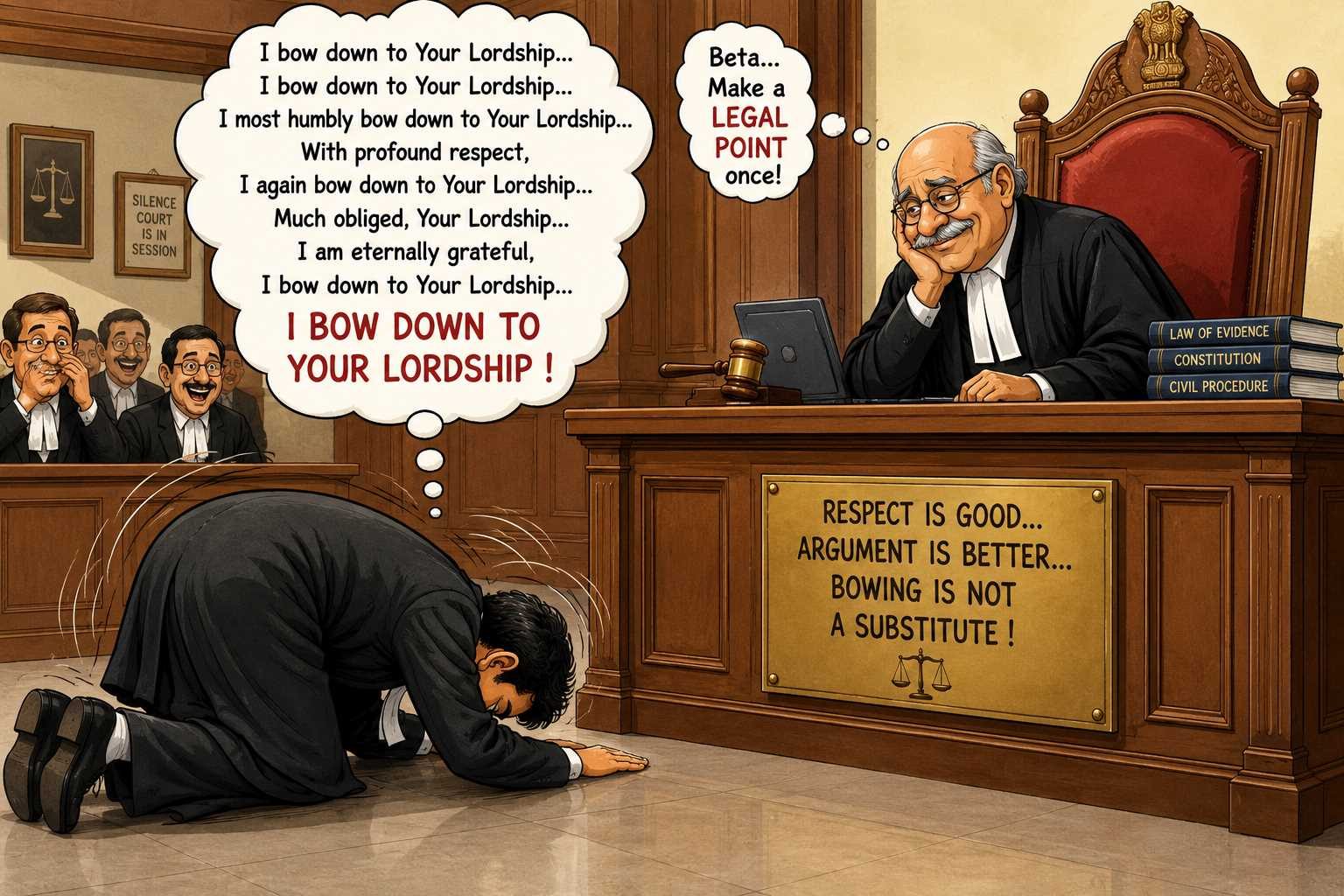
There is a new species emerging in our courtrooms. He is young, energetic, well-dressed, armed with a laptop, three volumes of judgments—and an apparently inexhaustible capacity to bow with humble declaration - “I bow down to Your Lordship”.
At this rate, by the time the matter reaches final hearing, the learned counsel may require treatment for chronic back pain!.
Courtesy is not competitive bowing. Respect for the Court is fundamental to our profession. Courtesy, restraint and dignity are among the finest traditions of the Bar. But somewhere along the way, ordinary courtroom courtesy appears to have been upgraded into a competitive sport.
A young advocate need not verbally prostrate himself every thirty seconds to establish that he respects the institution. The Judge already knows that you respect the Court. You have spent considerable time and explain the facts and articulate the legal points. You answer the questions of the Judge without misleading. What greater proof of devotion is required?
There is also no need to announce, “I am most grateful to Your Lordship” merely because the Judge has asked you to turn to page 47. Page 47 is not judicial charity.
You are an advocate, not a palace attendant. An advocate stands before the Court with a constitutional and professional responsibility. He is there to assist the Court, defend his client and make a proposition of law.
Imagine this:
Judge: “Mr. Counsel, I don't agree with you.”
Counsel: “I bow down to Your Lordship.”
No!
That is precisely when counsel should respectfully say:
“Your Lordship, I shall demonstrate why the proposition requires reconsideration”
That is advocacy.
A lawyer who agrees with everything the Judge says is not necessarily courteous.
Keep the head high—and the proposition higher
The great pleasure of watching a fine advocate is seeing respectful disagreement.
That is infinitely more impressive than twelve bows, seventeen “much obligeds” and a final surrender of all known constitutional rights.!
The Court does not require advocates to crawl towards a legal proposition. The proposition can walk perfectly well on its own legs.
“Much obliged” has suffered enough. There should perhaps be a Bar Council welfare scheme for overworked expressions. “Much obliged” deserves immediate rehabilitation. So does “I bow down.” These expressions have been made to work overtime without salary, leave or retirement benefits.
One occasionally wonders whether counsel is arguing the case or conducting the closing ceremony of a Commonwealth summit.!
Conclusion. Respect the Judge. Preserve the Advocate. There is a profound difference between respect and submission. Judges do not expect submission. When they expect respect, it is for the Court. Respect belongs to the institution. Independence belongs to the advocate. Both must coexist.