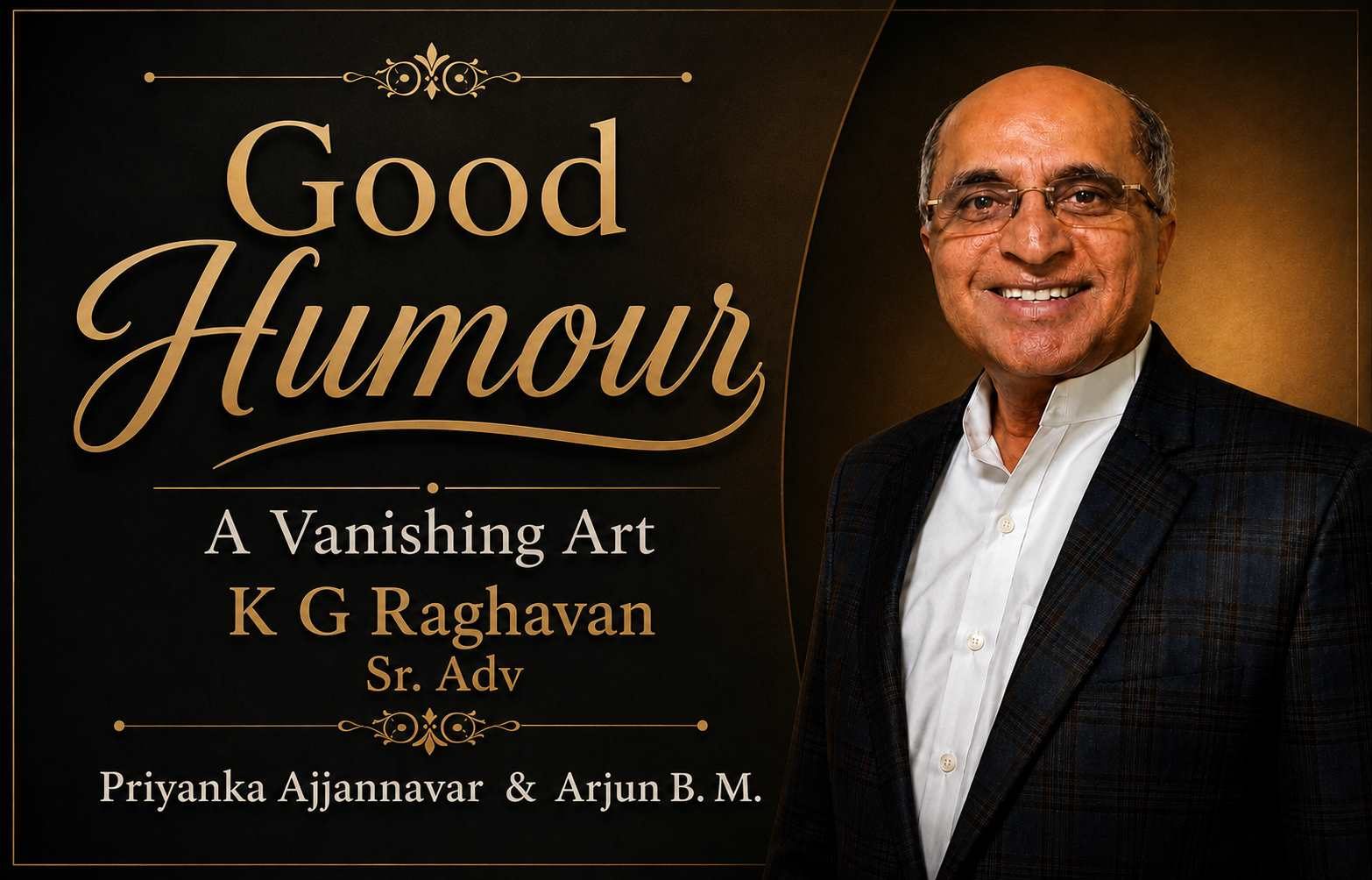
Good Humour: A Vanishing Art.
“A day without laughter is a day wasted.” — Charlie Chaplin
Introduction
Courtrooms rest on solemnity: robed judges and lawyers, formal addresses, strange legal lingo beyond the comprehension of the lay litigating members of the public occupying the last few benches of the courtroom, and, not to omit mention, the grand entry of the judges into the courtrooms led by a liveried usher holding an awe-inspiring silver mace. All this takes place in a teakwood-paneled hall.
Beneath this solemnity runs a persistent thread of wit between Bench and Bar steeped in tradition. Wit and humour are not necessarily acquired qualities. Most of the time, if not all, they are inherent qualities. The question is not whether courtroom humour has existed; the records leave no doubt of it. The real question to ponder is its legitimate place in the modern judicial process given the procedural formalism, heavier caseloads, and the inability to discriminate between humour and sarcasm.
A workable and acceptable norm of humorous behavior has to be found consistent with courtroom dignity. Humour is a playful dialogue. It is a communicative skill as much as it is the exhibition of an innate trait.
Humour is not merely aesthetic in its content. Humour in court is not an academic exercise. It should be appropriate. It should gel with the circumstances and be contextual. That is the inviolable “rule”. Appropriate laughter is linked to reduced stress and stronger interpersonal trust. Humour should be cultivated consciously and be sustained. Sustained because, statistics indicate that the capacity for laughter itself appears to shrink with age: a four-year-old laughs some 300 times a day; an adult past 20 manages 15 to 20; by 40 the average falls to four.
Healthy humour is the hallmark of a gentleman and a gracious lady. It is an inherent and inseparable part of tactful advocacy. Humour has two attributes, namely: tone and target. On this basis, humour can be classified into two groups: Positive humour and Negative humour.
In positive humour, the tone has to be gentle, polite, and soft. So too, it should be a joke at one’s own expense rather than mocking others. Such humour builds rapport and eases tension.
Negative humour has sarcasm, ridicule, mockery of appearance, religion, race, gender or disability as its attributes. It sullies the atmosphere; builds barriers and destroys professionalism.
Sir Edward Clarke was a great English barrister, well known for his elegant, restrained and strategic humour in court. His humour neither offended the bench nor the opposing counsel. When a judge remarked to him that the court cannot accept every one of his submissions at face value, an unmoved Clarke gently remarked,
“I never expect your Lordship to believe everything I say. I only ask that your
Lordship should doubt everything my learned friend says.”
Mr. G. Ramaswamy was a leading counsel in the Indian Supreme Court. He was the Attorney General of India. Appearing for a corporate entity, Mr. Ramaswamy pleaded that his client was poor and in great hardship. The Court pointed out to Mr. Ramaswamy that the balance sheet of the company on record indicated otherwise. Faced with this predicament, Mr. Ramaswamy politely retorted:
“I know, My Lord. That was before they engaged me!”
A conceptual outlook
Humour is not equivalent to a joke book. It has to be pertinent, measured and appropriate. Karen N King expounded a four-step characterization of humour as a disciplined skill. She gave it the acronym “WRAP”.1
W - Watch for humour as it occurs naturally in social interaction situations and observe the impact it has on others.
R - Risk using it yourself. How and when you will use it?
A - Analysis, was I successful in the use of humour in the circumstance?
P - Persevere, i.e., increase your ability to use it for positive ends in a wide variety of social situations.
In a TED Talk delivered by Andrew Tarvin, CEO of a leadership development company, “Humour that Works”, he famously compared humour to salt, “Humour is like the salt of a meal. You wouldn’t eat an entire meal of salt, would you?” In other words, humour should be measured. Too much is too bad. The potency of wit and humour lies in its brevity.2
To illustrate the above, a repartee in court may be recalled. An advocate arguing in an appellate court made a point which the judge thought was too elementary. And the irritated judge remarked, “Mr. Counsel, you are arguing a very elementary principle of law. Do you think I don’t know it?” The Counsel with composure replied, “that was the mistaken assumption I made in trial court, and I don’t want to make the same mistake in this court.”
A young lawyer present at the time of the pronouncement of a judgement was visibly upset that the judge had decided the case against his client. He burst out at the judge saying, “I’m surprised at the judgement.” The impetuous judge took objection to the remark of the young lawyer and issued a notice for contempt. The nervous young lawyer appeared the next day with his senior. The senior with all composure said, “My Lord, I agree that my junior was wrong in having said what he said. He still doesn’t know that one shouldn’t be surprised at anything that happens in court.” The subtle humour immediately compelled the judge to drop the contempt notice.
Humour should ease tension, build rapport, and aid persuasion. It should be self-directed or aimed at the absurdity of a situation rather than at a person. It shouldn’t be stereotyped and ridicule a litigant’s vulnerability, it should be used sparingly without delaying or impeding the progress of justice. Humour violating these conditions falls outside the rule’s protection.
Humour in formal relationships
Wit and repartee have long bonded formal relationships too. The anecdotal record from India, England and the United States fortifies the same.
Folk tradition supplies the earliest Indian illustration of humour. Tenali Rama is known for his courtroom wit and humour. A horse trader vanished after collecting 5,000 gold coins in advance from King Krishnadevaraya. Tenali was found listing the greatest of fools in the kingdom. Tenali Rama put the King’s name at the top of the list, for trusting a stranger with his money. Asked what would happen if the trader returned the money, Tenali replied that the trader would then be the biggest fool, and would inherit the listing on the top.
In another tale, people in the Vijayanagar kingdom believed that if they saw the face of a person named Ramaiya first thing in the morning, something untoward would happen to them on that day. The king wanted to test this belief. He called Ramaiya to his palace the next day in the morning. First thing in the morning of the next day he saw Ramaiya’s face. Lo and behold! The king lost his appetite to eat that day. He attributed this to Ramaiya and ordered his execution. Ramaiya’s wife approached Tenali Rama for help. Tenali Rama wrote a note and gave it to Ramaiya who passed the same onto the King. Ramaiya too had seen the King’s face first thing in the morning. The note very pithily said:
“If my sight first thing in the morning can do a small harm to the one who sees me, your sight first in the morning has cost my life. Who is more dangerous ? Me or You ?”
The king understood and released Ramaiya. That was the courtroom wit of Tenali Rama.
Modern Indian jurisprudence also gives insightful instructions as to how courtroom humour can be engaged. Article 19(1)(a) of the Constitution of India guarantees freedom of speech and expression. Is the right to be funny a part of the freedom of speech? This question was addressed by the Madras High Court in the case of Mathivanan v. Inspector of Police,3 and it was held that the right to be funny “can be mined” in
Article 19(1)(a). The Madras High Court, in fact, sought to include in Article 51A a duty to be funny.
Being funny is one thing and poking fun at another is different altogether. In the Madurai Bench of the Madras High Court, an interesting episode is stated to have happened between the Bar and Bench. The judge inquired from the lawyer, who was unendingly making submissions, whether the end was in sight.
“I will finish your Lordship”, assured the lawyer.
The judge replied, “Don’t finish me. Just your arguments.”
This humorous interlude indicates that neither the lawyer nor the judge were making fun of each other. It was just a circumstantial and light banter with pun on words.
On the web portal of the Delhi High Court there is a space exclusively dedicated to humour titled ‘Humour in court’. One such similar exchange between the Bar and the Bench is recorded.4
Senior Counsel: “If your Lordships will now turn to page 6 and the star on the left column”.
Judge: “The only stars I see are visible in the sky after 7pm. What you are referring to is an asterisk (*).”
Appropriate judicial humour can have a valuable role in the courtroom. Data from interviews with judicial officers and court observation studies demonstrate that judicial humour is a reality in the Australian courtroom and can be used positively.
Justice Keith Mason, in a Judicial Humour Law Graduation Address, said that,
“Humor is a legitimate expression of humanity and individuality. These are judicial virtues in the eyes of all except those who want courts to be staffed by robots preferably made in their own image.” 5
The Australasian Institute of Judicial Administration’s Guide to Judicial Conduct recognises the presence of humour, commenting that ‘the trial of an action, whether civil or criminal, is a serious matter but that does not mean that occasional humour is out of place in a courtroom, provided that it does not embarrass a party or witness’.
Former Australian High Court Justice Michael Kirby recalled surviving tedious hearings by sketching animals, colleagues, and exuberant barristers - a private, self-contained pastime used purely as a coping mechanism.6
In fact, my father, while serving as a judge of this court, maintained several registers filled with case notes that featured numerous sketches of animals and people; when asked, he explained these drawings as a mechanism for coping with boredom.
(Some caricatures done by my father are provided separately)
Humour also has a well-recognised role in mediation. In a mediation arising out of an alleged consumer fraud case, the plaintiff claimed that the defendant, a retail shop owner, had cheated him by levying a hefty amount to repair a video camera while it was still on warranty. The retailer explained that the cost of repairing the machine was covered by the warranty, but that there was a charge for opening the machine to determine the problem. The mediator asked if the vendor could think of any exceptions to this standard rule.
He thought briefly and then told of a young mother who had brought her malfunctioning video camera in to be fixed and, when the salesman picked up the machine, out fell half a dozen marbles! The mediator asked, “What is the charge for shaking out marbles?"
The salesman responded humorously, "No charge for shaking out the marbles.” This bit of light humour released a great deal of tension, and made the rest of the mediation run smoothly.
Humour and Irony
It should be further noted that Irony, satire and parody serve the same purpose more broadly, demolishing pride and challenging the intimidating authority.
Adjournment in courts has become a routine affair and has featured in the movie ‘Damini’. Damini, who is married into a wealthy family, witnesses her brother-in-law and his friends gang rape their housemaid. In a prosecution, Damini becomes a key eyewitness. The family’s powerful lawyer attacks Damini’s credibility instead of addressing the merits of the case. Portraying her as mentally unstable, she is temporarily confined to a psychiatric clinic by the court order. Damini escapes from the institution and engages Sunny Deol as her advocate. The phrase ‘Tareekh pe Tareekh’ is attributed in this movie to Sunny Deol in the context of the family's powerful lawyer asking for repeated adjournments and Damini herself being attacked outside the court. On one of the hearing days, Damini is unable to reach the court in time. Taking advantage of her absence, the defense seeks another adjournment. Sunny Deol remarks with anguish, concern, and a touch of wit:
"Tarikh pe tarikh... tarikh pe tarikh... tarikh pe tarikh milti rahi hai, My Lord. Lekin insaaf nahin mila. Mili hai toh sirf yeh tarikh."
“Date after date... hearing after hearing... all we've received are new hearing dates, My Lord. But justice has never been delivered.” 7
Getting adjournment in court is an art. A lawyer wanted to avoid a hearing before a particular judge. He sought an adjournment of the case pleading that he had forgotten his spectacles and therefore couldn’t read. The judge who knew the mischief behind the plea of adjournment, sportively offered his spectacles to this lawyer and asked him to proceed with the case and that he, as a judge, would hear his arguments. The lawyer was not to be outdone by the judge. He took his spectacles and wore them. He still insisted on an adjournment. When the judge asked him why, he very solemnly said, “I am viewing the case from your point of view.” The case was adjourned.
An anonymous mock Will attributed to a Wall Street broker, is a good example of irony and constructive use of healthy humour:
“To my wife, I leave my lover, and the knowledge that I wasn’t the fool she thought I was.
To my son I leave the pleasure of earning a living — for thirty-five years he thought the pleasure was mine; he was mistaken.
To my daughter I leave $100,000; the only good piece of business her husband ever did was to marry her.
To my valet I leave the clothes he has been stealing from me for ten years, and the fur coat he wore last winter at Palm Beach.
To my chauffeur I leave my cars — he almost ruined them, and may he finish the job.
To my partner, I leave the suggestion that he find another man to go into business with.” 8
Benjamin Cardozo, the great American judge was known for his liberal ideas and had acquired a reputation as a liberal judge contrary to being a conservative judge. A person mocking the reputation of the judge sent a letter, asking for $10. It said:
“I read in the newspaper that you are a liberal judge. Will you send me $10 as I am really very hard up.”
This is the risk of reputation being misunderstood.
Wit and ridicule can be weapons of offense and defense to lawyers. For Abraham Lincoln, the 16th POTUS, wit and ridicule were his offense and defense. He is credited with having humoured more jurors than any other person who practiced at the bar. One such incident pertaining to Abraham Lincoln is the following.
Lincoln began thus:
“GENTLEMEN, you must be careful and not permit yourselves to be overborne by the eloquence of the counsel for the defense. I know, is an effective lawyer. I have met him too often to doubt that; but shrewd and careful though he be, still, he is sometimes wrong. Since this trial began I have discovered that, with all his caution and fastidiousness, he hasn't knowledge enough to put his shirt on right.”
Logan turned crimson with embarrassment, and the jurors burst into a roar of laughter as they discovered that the discomfited advocate was wearing the garment in question with the plaited bosom behind, and for the rest of that trial Logan was not effective against his former partner.
Dark comedy
Debates on serious, disturbing subjects are commonplace in courts. They tend to make the court atmosphere dull, serious, and at times dreary. At these times, dark comedy comes in handy. Dark comedy, or dark humour, is a style of comedy that treats serious, disturbing, or taboo subjects such as death, illness, or warfare with bitter amusement.
It can help confront difficult truths and subvert aggressive narratives; though it may incite discomfort and teasing. It often does so to inquire rather than harm, sparking dialogue and fighting prejudice - only where perimeters are trodden carefully.
It is axiomatic to state that slavery as a subject is a serious one. William Grimes, a slave, in his book titled, ‘Life of William Grimes, the Runaway Slave’ made light of the torture he withstood and wrote:
“If it were not for the stripes on my back which were made while I was a slave, I would in my Will leave my skin as a legacy to the government, desiring that it might be taken off and made into a parchment, and then bind the Constitution of glorious, happy and free America. Let the skin of an American slave bind the charter of American Liberty, glorious, happy and free America.” 9
This is an instance of dark comedy.
Sarcasm is highly dangerous. It has its place, but in small doses and (again) only when it certainly works. Sarcasm is easily misunderstood and can agitate on the nerves of the judge if it flops.
In the Ankh Micholi case, the Apex Court stated in the context of persons with disability:
“Humour is a powerful medium of speech that can reinforce attitudes and influence behaviour towards groups. Pejorative jokes may reinforce stereotypical assumptions about disabilities, validating abusive attitudes and practices towards persons with disabilities.” 10
Standup comedies have come to stay. It is marked because of humour. An insensitive humour by standup comedian Samay Raina, reached Apex Court. In the case of Ranveer Gautam Allahabadia and connected matters, an insensitive humour at the cost of disabled persons was deprecated by the Apex court, and the direction was issued to the comedians to appear on platform and boost publicity for the cause of disabled by raising generous donations.
Courtroom humour serves a genuine function wherever it is self-deprecating or situation-directed rather than aimed at a vulnerable litigant. Free of stereotype, it should be deployed without hesitation and used in the literature’s recurring metaphor as salt rather than a substitute for competence or civility.
Chief Justice Brennan says,
“Self-deprecating judicial humour happens on occasion and can be appropriate”. He praises “a sense of humour that allows the mind to concentrate on the issues without taking oneself and one’s preconceptions too seriously.” 11
Interviews with Australian judicial officers suggest that there is an understanding and acceptance of judicial humour in court as well as an awareness of the risks. For example, one judge remarks that humour is important to some individuals and not to others.
“It’s important to me and I find myself doing it more than I probably should. It’s discouraged … in court … any number of appeal judges at conferences will tell you there’s no place for it … I find that difficult to accept and there’s not much I can do about it and so I restrain myself as much as I can but for me seeing the funny side of things is important and I don’t stop myself from doing it sometimes in court.”
The Indian and English situations above from Tenali Rama’s literal-mindedness to the mediator’s example exemplify this measure.
Seven Lamps of Advocacy
Wit and eloquence are among the Seven Lamps of Advocacy. The Seven Lamps of Advocacy are as follows:
Wit, Eloquence, Honesty, Industry, Integrity, Judgment and Fellowship.12
Courtroom is a complex environment. Words do have power and mean a lot to the people. To communicate effectively, lawyers should harness a wide spectrum of tone and delivery. That may include humour, anger and aggression. However, these tools should be used sparingly. The utility of judicial humour in relieving tension for lay people extends beyond reassuring judges and lawyers. It can also assist people giving evidence as a witness in the unfamiliar courtroom environment.
In the words of Thomas Mann, a Nobel laureate in Literature, “Laughter is the sunbeam of the soul.” 13
Conclusion
Mark Twain, in his posthumously published, a dark philosophical novel ‘The Mysterious Stranger’, made an excellent point about humour:
“Humanity has unquestionably one effective weapon—laughter. Power, money, persuasion, supplication, persecution—these can lift at a colossal humbug—push it a little—weaken it a little, century by century; but only laughter can blow it to rags and atoms at a blast. Against the assault of laughter nothing can stand”.14
The real and concerning question, therefore, is whether the courts and society in general are rendering humour a vanishing art form. Everyone—judges, lawyers, litigants, and members of civil society—must endeavor not to let this art form vanish.
References
1. Karen N King, Executive Director of the Tempe (Arizona) Community Action Agency. In her work, “But I’m not a funny person”.
2. Andrew Tarvin, “The Skill of Humour” TED Talk
3. Mathivanan v. Inspector of Police 2021 SCC OnLine Mad 6458.
4. ‘Courtroom Humour Reels Go Live: Delhi HC Launches “Humour in Court” to Share Witty, Memorable Moments Online’ The Economic Times (2024) accessed 7 July 2026.
5. Justice Keith Mason, ‘Judicial Humour Law Graduation Address’ (Speech delivered at The University of Sydney, 20 May 2005).
6. Sharyn Roach Anleu, Kathy Mack and Jordan Tutton, 'Judicial Humour in the Australian Courtroom' (2024) 46(1) Sydney Law Review 35.
7. Damini (1993), directed by Rajkumar Santoshi.
8. Michael Gilbert (ed), The Oxford Book of Legal Anecdotes (Oxford University Press 1986) 224.
9. William Grimes, Life of William Grimes, the Runaway Slave..
10. Nipun Malhotra v Sony Pictures Films India (P) Ltd 2024 SCC OnLine SC 1639.
11. Chief Justice Gerard Brennan, ‘The Role of the Judge’ (Speech delivered at the National Judicial Orientation Programme, Wollongong, 13 October 1996)
12. Edward Abbott Parry, The Seven Lamps of Advocacy.
13. Thomas Mann, The Magic Mountain
14. Mark Twain, The Mysterious Stranger